

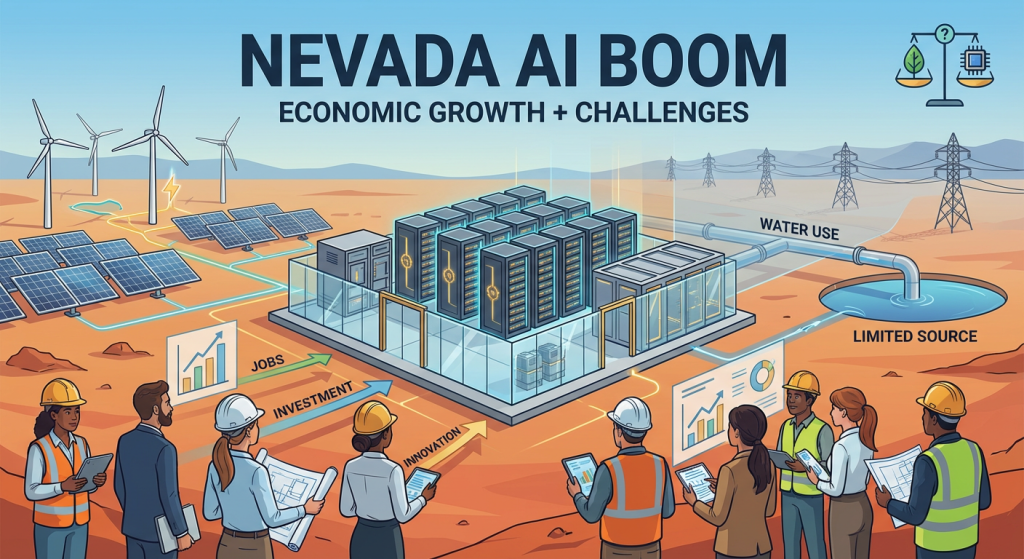
Nevada is rapidly transforming from desert landscapes into one of America’s emerging digital powerhouses. Companies are racing to build AI-ready data center campuses near Reno and Las Vegas. Consequently, the Silver State now stands at the intersection of technological growth and environmental responsibility. As AI infrastructure expands, local communities, investors, and policymakers must weigh economic benefits against resource consumption and sustainability.
Why Nevada Is Becoming an AI Hub
Ample Land, Strategic Location & Business-Friendly Climate
Northern Nevada offers vast undeveloped land, relatively low real estate costs, and proximity to West Coast population centers. In addition, a business climate with attractive tax incentives and no corporate income tax makes the state appealing compared to high-cost tech enclaves like Silicon Valley.
For example, Vantage Data Centers recently committed nearly US$3 billion to a 224 MW AI-ready campus (NV1) outside Reno. This investment signals that major players see long-term value in Nevada’s infrastructure.
Infrastructure Ready for High-Demand Workloads
Nevada also benefits from high-capacity power grids, strong data-infrastructure links, and relative safety from major natural disasters. These features are critical for the reliability big tech firms require. Moreover, data centers like NV1 support high-density AI workloads. They offer flexibility for both traditional air-cooled systems and next-generation GPU clusters using liquid cooling.
Economic Upsides: Jobs, Investment, & Regional Growth
Capital Inflow and Construction Employment
The construction of new campuses is already bringing jobs to the region. Vantage expects to employ over 1,200 people during build-out and ongoing operations. Furthermore, large-scale developments increase demand in supporting sectors, including local services, logistics, maintenance, security, and facility management. These ripple effects can uplift communities around Reno, Storey County, and beyond.
Diversifying the Local Economy
Nevada’s economy has traditionally relied on gaming, tourism, and logistics. However, the growing tech-infrastructure sector could attract complementary industries, such as renewable energy, engineering services, and software development. As a result, residents may gain long-term, higher-skilled job opportunities.
Environmental & Infrastructure Challenges
Soaring Energy and Water Demand
AI-ready data centers are notoriously resource-intensive. In Nevada, data centers accounted for 8.69% of statewide electricity consumption in 2023. By 2030, this share could rise to 20%. Meanwhile, the ultra-arid climate raises concerns about water usage. Operating a single data center at full AI-load capacity can require massive volumes of water for cooling and heat management. Clearly, this is a steep cost in regions where water is scarce.
Sustainability Tensions and Long-Term Viability
Some operators attempt to mitigate impact. For instance, NV1 is being built with a closed-loop cooling system to reduce water demand and aims for LEED-certified design. However, critics note that massive tax abatements — sometimes up to 75% — shift the burden. While companies gain financially, local communities may face reduced public funds for services. Utilities may also struggle under growing demand.
What This Means for Nevada Residents & Policymakers
- Balanced regulations: Local governments, such as Reno city authorities, should require data centers to offset environmental costs through renewable-energy sourcing or water-usage caps.
- Transparent resource planning: Utilities and regulators should forecast load increases and plan grid upgrades to prevent disproportionate costs for households.
- Community benefit strategies: Policymakers should encourage operators to invest in local workforce training, stable employment, and social infrastructure. This approach maximizes community gains beyond construction jobs.
- Sustainable energy transition: Encouraging renewables and efficient cooling technologies can help Nevada’s tech growth align with environmental stewardship.
Conclusion
Nevada’s transformation into a major AI and data-center hub reflects a new kind of boom — not mining gold, but computational power. Economic benefits, from job creation to industrial diversification, are real and substantial. Yet resource demands — water, electricity, environmental impact — present serious challenges. As more companies build AI campuses across Northern Nevada, the state’s leaders and communities must balance growth with sustainability. With thoughtful policies and community-focused planning, Nevada could achieve a high-tech yet environmentally conscious future.
References
- Vantage Data Centers invests US$3 B for AI campus in Storey County, Nevada (Vantage Data Centers, Intelligent Data Centres)
- Data-center demand boosts Nevada electricity consumption — from 8.69% in 2023 toward 20% by 2030 (The Nevada Independent)
- Growth of data centers and challenges of water/power in Northern Nevada industrial expansion (Great Basin Sun, Forbes)
- Details on design, cooling, and sustainability efforts for AI workloads in Nevada centers (Business Wire, Telecom Ramblings)